-
Total Active Hub
What Keep Britain Working Means for How You Invest in Employee Physical Wellbeing
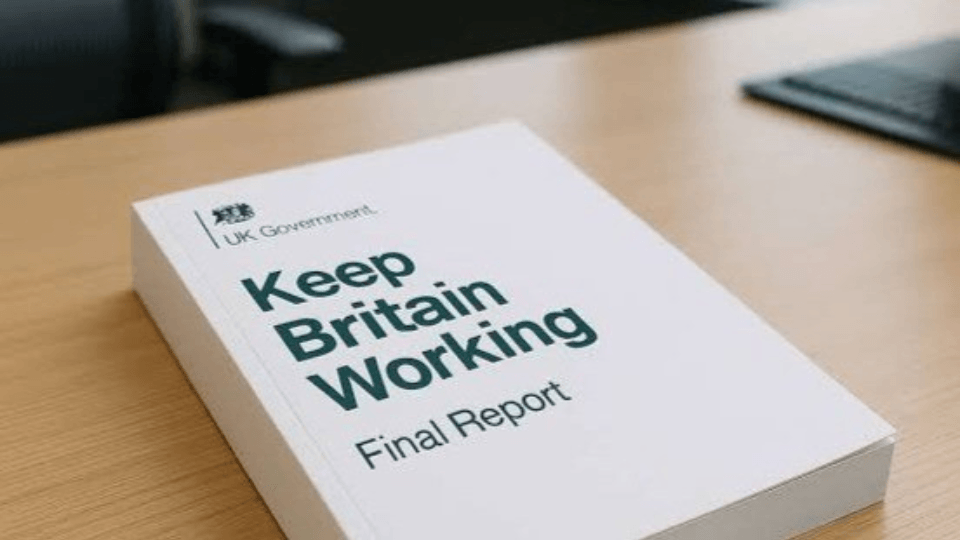
Sir Charlie Mayfield’s Keep Britain Working Review lands a blunt message: ill-health has become one of the biggest drivers of economic inactivity in the UK, and employers, not just the NHS, have to lead on prevention. For anyone who invests in employee wellbeing, that reframes the question. It is no longer about which perks to offer, but about what genuinely keeps people healthy and in work. Physical wellbeing sits closer to the centre of that answer than most benefits packages assume. Here is how I read the review, and where movement fits.
The issue
The scale is hard to overstate. The review sets out a workforce sliding into an avoidable crisis:
- Over one in five working-age adults are now out of work, substantially because of health problems, with 2.8 million economically inactive due to ill-health, 800,000 more than in 2019, and a further 600,000 projected to leave by 2030.
- The cost is enormous: £212 billion a year to the state and around £85 billion a year to employers, with sickness absence at a 15-year high and 50 per cent above 2019 levels.
- Each day of sickness absence costs roughly £120 in lost profit, 150 million days are lost a year, and presenteeism adds the equivalent of four to nine lost days per person through poor decisions, slower recovery and spread of illness.
What should catch the eye of anyone responsible for wellbeing is which conditions are doing the damage. The review is clear that older workers are leaving primarily because of musculoskeletal problems, while among young people there has been a 76 per cent rise since 2019 in those becoming inactive with a mental health condition. Those are precisely the two areas where regular movement has the most to offer.
Crucially, the review says this is not mainly a spending problem. Employers already invest billions in health and wellbeing. The money is simply fragmented and misdirected, described in the report as a confusing patchwork, or a random set of explosions, with no clarity on what works.
The solution
Mayfield’s answer is a shift from health being left to the individual and the NHS towards shared responsibility, with employers on the front foot for prevention. For how you invest in physical wellbeing specifically, that points to three moves:
- From reactive to preventative: acting before a musculoskeletal niggle or a dip in mood becomes a sickness note.
- From perks to participation: spending that reaches the whole workforce, not just the already-active few who need it least.
- From one-off campaigns to always-on: support built into the working week rather than a launch event that fades by February.
Movement is one of the most direct and lowest-cost forms of prevention available, and it maps neatly onto the review’s two biggest cost drivers. Regular activity is frontline support for musculoskeletal health, and a 2023 review in the British Journal of Sports Medicine found physical activity can be highly effective in reducing symptoms of depression and anxiety. It complements professional care, it does not replace it, but as prevention it is difficult to beat on cost or reach.
The impact
The review puts hard numbers on why prevention pays, drawing on returns that are hard to ignore:
- Employee Assistance Programmes: around £8 back for every £1 invested (EAPA).
- Mental health and wellbeing investment: about £4.70 per £1 (Deloitte).
- Musculoskeletal interventions: £11 to £99 per £1, depending on the intervention (Public Health England).
- Employers cited in the review reported returns of £7 to £24 per £1.
At a system level, the review estimates direct benefits of £3 to £8 billion a year, rising to £9 to £18 billion as adoption matures. For an individual employer the logic is simpler still: reduce absence and presenteeism even modestly and you protect both your people and your margins. In the review’s own words, the priority is to get employers off the sidelines and onto the pitch.
What’s the place for Total Active Hub?
This is the shift we built Total Active Hub for. We treat movement as infrastructure rather than a perk, and we design it for the silent majority the review worries about most, the people a conventional wellbeing offer never reaches. In practice that means:
- Prevention that reaches everyone: inclusive, low-barrier formats, walking above all, that engage people who will never touch a gym benefit.
- Consistency over intensity: our Active Rewards pay out for turning up, repeatedly, because that is what builds the habit that keeps musculoskeletal issues and low mood at bay.
- Directing existing spend better: not another disconnected initiative, but an always-on programme that gives your existing wellbeing budget a measurable job.
The results back it up. Over two years of rewarding movement we have seen a 57 per cent increase in the number of people taking part. With Circle Health Group, 95 per cent of participants told us they felt more motivated to move, and in one organisation engagement climbed from 15 per cent to 60 per cent, against an industry benchmark where wellbeing schemes typically reach 15 to 25 per cent of staff. That is prevention actually landing with the people who need it.
If you are rethinking your wellbeing spend in light of Keep Britain Working, and you want it pointed at prevention that genuinely reaches your workforce, that is the conversation we have every week. We would be glad to talk it through.
Contact Tony Eames, Founder of Total Active Hub at tony@totalactivehub.com.
About Total Active Hub
Total Active Hub is a workplace movement platform that helps organisations make physical activity inclusive, rewarding and part of everyday working life. Built around consistency over intensity, our always-on approach and Active Rewards are designed to reach the silent majority most wellbeing programmes miss, turning movement into a lasting habit that supports both physical and mental health.
To find out more or book a conversation, get in touch at info@totalactivehub.com.
-
Total Active Hub Announces Partnership With ASICS EMEA
news
by
Total Active Hub
-

National Fitness Day 2026: How Your Workplace Can Get Involved
blog
by
Total Active Hub -

Why 20 Minutes a Day Could Be the Healthiest Habit You Ever Build
blog
by
Total Active Hub -

50 Ways to Complete Your 20 Minutes of Movement Every Day
blog
by
Total Active Hub
-

-
Success Stories
Every day, hundreds of activities are recorded across Total Active Hub, by users wanting to make a real difference to their physical health.
Our users are empowered by their employers to move at least 150 minutes per week whilst being rewarded with numerous incentives such as charity donations, trees and school meals.
Why not take a few moments to read and be inspired by our real-life success stories?
