-
Total Active Hub
National Fitness Day 2026: How Your Workplace Can Get Involved
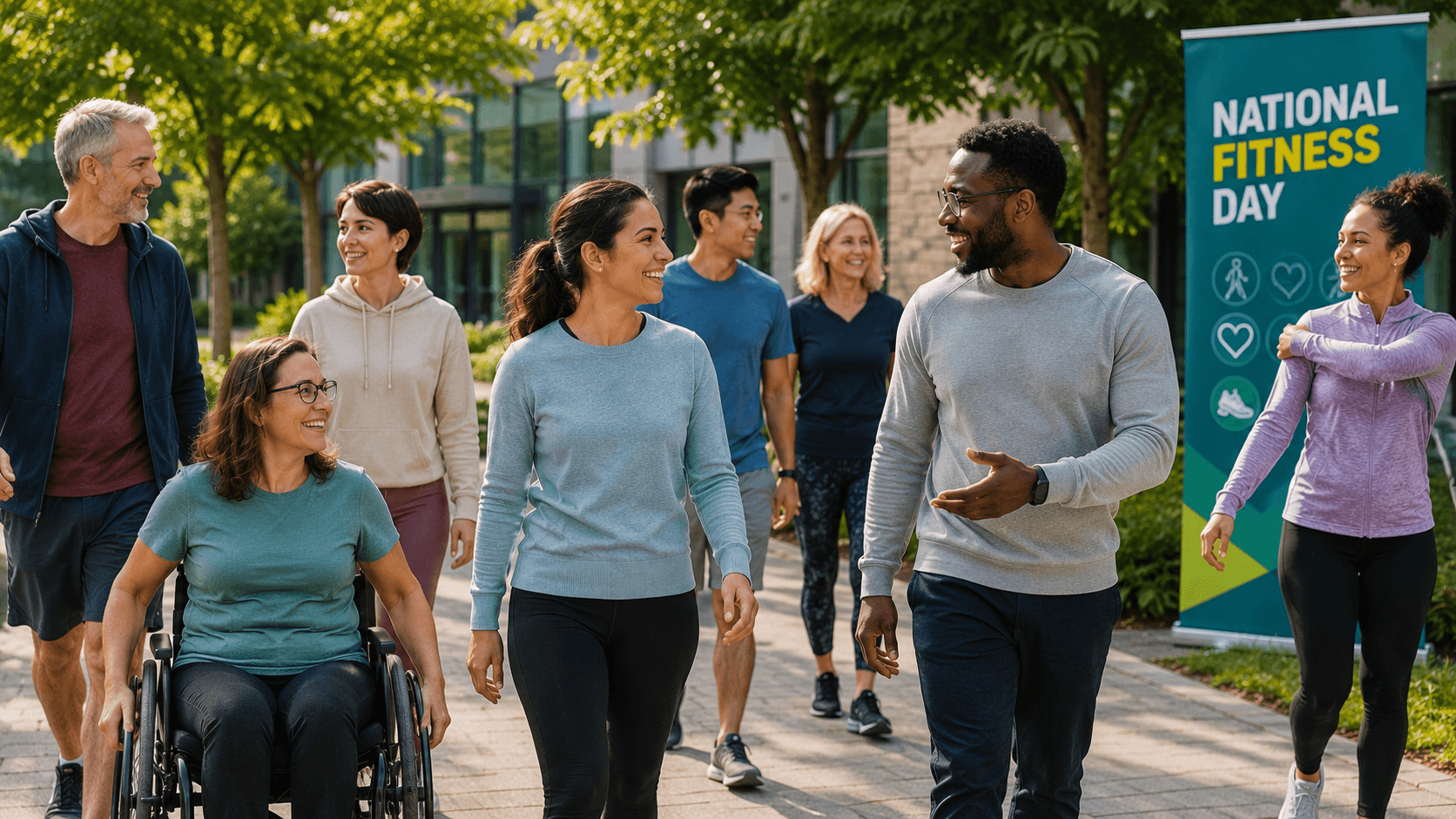
National Fitness Day 2026 falls on Wednesday 16 September.
Now in its fifteenth year and coordinated by ukactive, it is the UK’s biggest annual celebration of physical activity, with gyms, leisure centres, workplaces and community venues across the country opening their doors and running free sessions to get people moving.
For workplaces, it is a genuinely useful prompt — a fixed date in the calendar that gives permission to make movement visible and social for a day.
Handled well, 16 September is not the event; it is the start of something that carries on afterwards.
Why the day matters for employers
The case for taking part goes well beyond a fun afternoon. Sport England’s Active Lives Adult Survey for November 2024-25 found 64.6% of adults — around 30.9 million — active at the recommended 150 minutes a week, the highest on record, yet more than a third of adults still fall short, and inactivity is far from evenly spread. Disabled adults, for example, are far more likely to be inactive than non-disabled adults, at 39.3% against 19.7%.
There is a financial dimension too. The Office for Health Improvement and Disparities estimates physical inactivity costs the wider economy around £7.4 billion a year, including roughly £1 billion to the NHS, while Sport England has put the potential cost to the public purse as high as £20 billion.
A single awareness day will not shift those numbers, but it can open a door to the people your wellbeing programme usually fails to reach.
Ideas to get your workplace involved
The best National Fitness Day activities are inclusive by design — low-barrier enough that someone who never joins in feels able to. A few that travel well across office, hybrid and frontline teams:
- A whole-team walk. Set a shared, modest goal — a lunchtime walk anyone can join, with no pace or distance pressure.
- Walking meetings. Replace one or two meetings with walking versions. It is the easiest change to make and the easiest to keep afterwards.
- Movement breaks. Short, optional 10-minute mobility or stretch sessions that suit people who would never book a class.
- A virtual challenge. Give dispersed and remote staff a way to take part from wherever they are, so the day is not just for head office.
- Leaders in trainers. Have senior leaders visibly join in. Participation from the top has a marked effect on whether everyone else feels able to.
- Celebrate consistency. Recognise everyone who took part, not just the fastest or fittest, so the silent majority feels included.
Make it inclusive, not intimidating
The quickest way to lose the people you most want to reach is to make the day look like it belongs to the already-fit. Skip the competitive leaderboard, lead with walking as the lowest-barrier format, and make it clear that ten quiet minutes counts every bit as much as a lunchtime run.
The employees who benefit most from moving are usually the ones most easily put off, so the tone you set on the day matters as much as the activities themselves.
Turn one day into a habit
A single day rarely changes behaviour on its own. The research on habit formation from Lally and colleagues at University College London (2010) found it took an average of 66 days for a repeated action to become automatic. That is the real opportunity in National Fitness Day: use the energy of 16 September to start something, then keep a light, always-on rhythm going in the weeks that follow so the momentum does not evaporate by October.
Practically, that means deciding before the day what happens after it — a standing weekly walk, a rolling challenge, a small recognition for turning up regularly.
The day gets people through the door; the follow-through is what keeps them moving.
If you would like a steer on how to use National Fitness Day 2026 as the launchpad for something that lasts beyond a single Wednesday, we are happy to talk it through.
Sources
ukactive — National Fitness Day 2026 takes place on Wednesday 16 September 2026 (now in its 15th year).
Sport England, Active Lives Adult Survey November 2024-25 (published April 2026) — 64.6% of adults (around 30.9 million) active; disabled adults 39.3% inactive vs 19.7% of non-disabled adults.
Office for Health Improvement and Disparities / Public Health England — inactivity costs approx. £7.4 billion to the wider economy and approx. £1 billion to the NHS; Sport England estimates up to £20 billion to the public purse.
Lally et al., University College London (2010), European Journal of Social Psychology — average 66 days to form a habit (range 18-254 days).
UK Chief Medical Officers’ Physical Activity Guidelines (2019) — 150 minutes of moderate activity a week.
-

Why 20 Minutes a Day Could Be the Healthiest Habit You Ever Build
blog
by
Total Active Hub
-

50 Ways to Complete Your 20 Minutes of Movement Every Day
blog
by
Total Active Hub -
100 Funny Team Names for Your Fitness Challenge
blog
by
Total Active Hub -
Day-One SSP: The Cost of Inactivity Just Went Up
blog
by
Total Active Hub
-
-
Success Stories
Every day, hundreds of activities are recorded across Total Active Hub, by users wanting to make a real difference to their physical health.
Our users are empowered by their employers to move at least 150 minutes per week whilst being rewarded with numerous incentives such as charity donations, trees and school meals.
Why not take a few moments to read and be inspired by our real-life success stories?
