-
Total Active Hub
The Reality of Corporate Gym Discounts
There’s a question I ask that makes a room go quiet.
Your organisation offers a gym discount. How many of your people move more because of it?
Not how many are eligible. Not how many clicked. Not how many redeemed a code in the second week of January. How many are more active today than they were before you bought it?
Either read on or take the Gym Benefit Reality Check.
If you can’t answer that, you have just found the reality of corporate gym discounts. It isn’t that they fail. It’s that nobody is asked to prove they work.
We have been counting the wrong thing
We’ve become very good at giving employees access to things. Gym discounts. Apps. Benefits. Portals.
Access is easy to buy, easy to launch and easy to report. “100% of our people are eligible” looks magnificent on a slide.
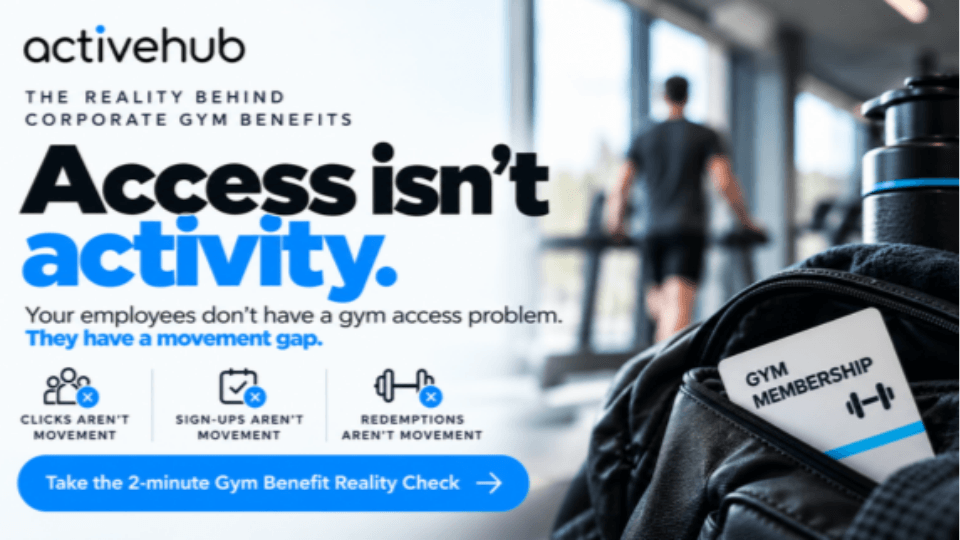
But access isn’t the outcome.
Being eligible for a discount doesn’t mean you use it. A click isn’t movement. A redemption isn’t sustained activity. Even a membership proves very little. Nobody ever got fitter from a direct debit.
Picture an employer with 10,000 people, all of whom can access a fitness benefit. The interesting number isn’t 10,000. It’s the answer to these:
- How many actually use it?
- How many use it consistently?
- How many became more active because of it?
- How many were inactive before and aren’t now?
Most wellbeing dashboards stop before question one. We report the size of the door and never count who walks through it.
The 6% question
Here’s a statistic every HR and wellbeing leader should stop and think about.
Epassi UK runs GymFlex and describes its network as the UK’s largest for fitness. If anyone has the data on gym benefits, they do. So let’s use theirs, for this example.
Epassi’s own research tracked 600 companies. Those offering GymFlex without an employer subsidy averaged just 6% take-up. Where the employer contributed at least £100 per employee per year, average take-up rose to 30% (Epassi UK, The Power of a Gym Membership Subsidy).
Now flip that first number over. In the unsubsidised companies, 94% of eligible employees didn’t take up the gym benefit. Go back to our employer of 10,000 people. That’s 9,400 of them. And even where the employer put money in, seven in ten still didn’t.
This isn’t about one company, and Epassi isn’t an outlier. Hussle, the multi-gym pass provider, says much the same in its own material: traditional gym membership schemes usually get fewer than 5% of employees taking part, while multi-gym access often reaches 15 to 20% (Hussle, November 2023).
Two providers. Their own numbers. One conclusion: the gym-benefit industry already knows it has a participation problem.
Credit where it’s due, 15 to 20% is progress. But at 20%, four in five of your people are still on the outside.
This doesn’t mean gym discounts have no value. For the people who want them, they can be a great benefit. But it raises a much bigger question:
What’s your movement strategy for the other 94%?
And take-up isn’t activity. Someone accepting a benefit tells you nothing about how often they move, whether they keep it up, or whether anyone who was inactive has become active.
Epassi seems to see part of the problem itself. Its 2026 benefits study found that 74% of UK employers say they encourage their people to be physically active, while only 53% of employees agree. Its own explanation is that many initiatives are “offered but not experienced” (Epassi UK, August 2026). Quite.
Access isn’t activity. A gym discount isn’t an active workforce strategy on its own.
I’m not anti-gym
I’m anti pretending that giving somebody a gym discount means you’ve solved physical wellbeing.
Gyms are brilliant for the people who use them. So ask yourself who that is. Is it the colleague who hasn’t exercised in five years? Or the one who already had a membership and is delighted you now pay for part of it?
There is evidence worth sitting with here. When researchers ran a randomised trial of a workplace wellness programme across 12,459 university employees, they found that the people who signed up already had healthier behaviours and lower medical costs than those who didn’t, before the programme had even started (Jones, Molitor and Reif, 2019). That was a wellness programme, not a gym discount. But the pattern should make every benefits buyer uneasy: opt-in wellbeing tends to find the people who needed it least.
So you may be subsidising the already active and calling it a wellbeing strategy.
So who are the other 94%?
The night-shift worker. The driver. The carer with no spare hour. The person who finds gyms intimidating. The colleague who lives 40 miles from the nearest partner site.
A gym discount asks all of them to come to the benefit. It does nothing to bring movement to them.
I call the result the Movement Gap: the difference between the people you give an opportunity to be active and the people you actually help to move consistently.
Every employer has one. It won’t appear on your benefits dashboard, because the dashboard was built to count access.
And to be fair, the person ignoring your gym discount isn’t necessarily inactive. They might run, cycle or play five-a-side every week. Which is rather the point. You don’t know. You have no idea who is moving and who isn’t, and you are making spending decisions anyway.
A gym discount isn’t a movement strategy. It’s a benefit. A strategy has a target (everyone), a measure (movement) and a plan for the people it isn’t reaching.
Five questions to ask your gym-benefit provider
Send these this week. The replies will tell you more than any annual report.
- What percentage of our eligible employees used the benefit in the last 90 days?
- Of those who took it up, how many are still using it six and twelve months later?
- How many of our people are more active than they were before?
- How many were previously inactive?
- What does this cost us per actively participating employee, rather than per eligible head?
If the answer to any of them is “we don’t track that”, you have found your Movement Gap.
This isn’t an accusation. Providers report what they are asked to report. The fault lies with the question the whole industry, employers included, has been happy to ask: how many people have access?
It’s time for a harder one. Are we actually helping our people move more?
Find your Movement Gap
We’ve built the Gym Benefit Reality Check: a few short questions that show how much of your workforce your current approach appears to reach, how much you can see after someone takes up the benefit, and whether you are measuring movement or just access.
Take the Gym Benefit Reality Check.
I know not everyone in the employee benefits industry will agree with me, and that’s fine. If your numbers tell a different story, I’d love to see them. This is a conversation worth having.
-
New National Campaign Challenges UK Workplaces to Move 20 Minutes a Day
news
by
Total Active Hub
-
What Keep Britain Working Means for How You Invest in Employee Physical Wellbeing
blog
by
Total Active Hub -
Total Active Hub Announces Partnership With ASICS EMEA
news
by
Total Active Hub -

National Fitness Day 2026: How Your Workplace Can Get Involved
blog
by
Total Active Hub
-

-
Success Stories
Every day, hundreds of activities are recorded across Total Active Hub, by users wanting to make a real difference to their physical health.
Our users are empowered by their employers to move at least 150 minutes per week whilst being rewarded with numerous incentives such as charity donations, trees and school meals.
Why not take a few moments to read and be inspired by our real-life success stories?
