-
Total Active Hub
World Mental Health Day: What Movement Did for My Mind
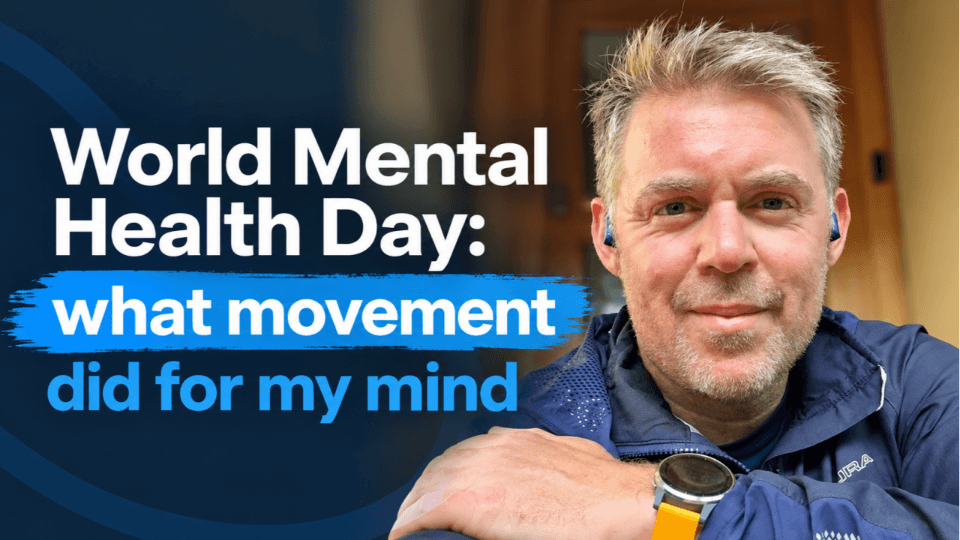
Today is World Mental Health Day. Most weeks I write about workplaces, data and how to get more people moving. Today I want to write about something closer to home: my own mind, and the times it hasn’t been in a good place.
I don’t find this easy to share. I run a company built around movement, and people tend to assume that means I’ve always had my own health sorted. I haven’t. The honest version is that Total Active Hub exists because, at one point in my life, I was struggling.
So this isn’t a piece about the business. It’s about me, about burnout, about losing my mum, and about the one thing that has helped me every single time.
The corporate years
In my corporate years I worked at Samsung & HP Inc. and I want to be clear about something: it was an amazing job. Working at Samsung was probably the fastest period of growth in my whole career. I was learning constantly, working on innovative things and leading teams, and I loved every minute of it.
That was the problem. When you love what you do, nobody has to push you to overdo it. I was burning the candle at both ends, and I was doing it willingly.
And it wasn’t only the day job. Alongside it, I was the co-founder of a brand new primary school and its first chair of governors. It was something I cared about a great deal, and it was a second demanding commitment stacked on top of the first. Work you love can burn you out just as surely as work you hate.
Over time, my physical health and my mental health both suffered. I burnt out. I struggled with my own mind in a way I hadn’t expected and didn’t know how to talk about.
The thing about burnout is that there’s rarely one bad day you can point to. It builds quietly while you’re busy being busy. You tell yourself it’s just a demanding period, that it will ease after the next deadline, the next quarter, the next promotion. It doesn’t ease. You just get better at ignoring it.
What I understand now, and didn’t then, is how closely body and mind are tied together. I had treated them as two separate problems, one to deal with later and one to push through. They were never two problems. They were one.
Rowing, and the alarm clock
What turned things round for me was rowing.
There was nothing clever about it. I got up in the morning and I rowed. Then I got up the next morning and did it again.
The rowing mattered. But looking back, the consistency mattered more. Getting up each morning and doing the thing I’d said I would do gave me back something I had lost: a small promise to myself, kept. When your head is noisy and everything feels out of your hands, one kept promise a day is worth a great deal.
It also gave me a part of the day that belonged to nobody else. No inbox, no meetings, no one needing an answer. Just effort, rhythm and breathing. For that stretch of time my mind had one simple job, and it was a relief to give it one.
Morning by morning, I started to feel like myself again. Nothing dramatic happened. There was no breakthrough moment. I simply noticed, some way in, that I was coping better, sleeping better and thinking more clearly than I had in a long time.
That experience is, ultimately, what led to Total Active Hub. I had felt what regular movement did for my own mind, and I wanted to make it easier for other people to find the same thing. That’s all I’ll say about the business today.
The heart I have to plan around
There’s one more thing I should mention, because it shapes all of this. I have an underlying heart condition, sudden death heart syndrome.
It means I can’t treat exercise casually. I have to think constantly about how I move, how hard I push and how I manage my own health. Going flat out for the sake of it isn’t an option for me.
You might expect that to put me off movement altogether. It has done the opposite. It has taught me that being active was never about intensity or personal bests. It’s about finding the kind of movement that works for your body and your circumstances, and then doing it regularly.
I’ve told more of that story on film. If you’d like the fuller version, you can watch it here: Our Founder’s Story.
When my mum died
Nothing prepares you for losing your mum.
I want to be careful here, because I would hate anyone to read this and think I’m saying that exercise fixes grief. It doesn’t. You can’t out-train a loss like that, and you shouldn’t try.
But movement helped me, even then. It gave my days a shape when I badly needed one. It gave me time alone with my thoughts, without having to explain them to anyone. And it gave the sadness somewhere to go.
The habit I had built years earlier, in a very different kind of struggle, was still there when I needed it most. I didn’t have to find the motivation. I just had to do what I already knew how to do: get up and move. I kept moving through that period, and I’m certain I came through it better than I would have done sitting still.
The silent walk
I still struggle sometimes. I think it matters to say that, today of all days. Running a business is not gentle on the mind, and there are days when my thinking gets loud, fast and unhelpful.
When that happens, I know what works for me. I go for a silent walk.
No podcast. No music. No phone calls. Just me, walking.
It sounds almost too simple to be worth writing down. But somewhere along the way, the noise settles. My thinking calms. The thing that felt enormous at my desk goes back to its real size, and I get the space to reflect on it properly instead of just reacting to it.
I think the silence is the part most of us skip. We’ve become very good at filling every spare minute with someone else’s voice. A walk with headphones in is still good for you. A walk without them is where I do my actual thinking.
What I’ve learned
I’m not a clinician, and movement is not a substitute for professional help. If you are really struggling, please talk to someone: your GP, a friend, a colleague, a helpline. That first conversation is a first step in its own right.
What I can offer is what I’ve lived.
Body and mind are one system. I spent years treating them as separate, and I paid for it. When I look after one, the other follows. When I neglect one, the other follows that too.
Consistency beats intensity. It was never the hard sessions that helped my head. It was showing up, morning after morning, on the days I didn’t feel like it as much as the days I did.
Build the habit before you need it. The routine I built to get out of burnout was the same one that carried me through grief. You can’t build that in the middle of a crisis. You build it on the ordinary days.
Silence is underrated. Some of the best things I’ve done for my mental health have involved no equipment, no kit, no app and no noise. Just a walk, and the patience to let my own thoughts settle.
It doesn’t have to be sport. Rowing was my way in. Yours might be walking the dog, swimming, gardening or dancing round the kitchen. What counts is that you move, and that you keep doing it.
One ask for today
If you’re in the place I was in during those corporate years, running on empty and telling yourself it will ease soon, I’d gently say this: it probably won’t ease on its own. Something has to change, and it can start very small.
So on World Mental Health Day, here’s my ask. Go for a walk today. Ten minutes is enough. Leave the headphones at home, and see what your mind does with the quiet.
And if movement has helped you through a hard time of your own, I’d love to hear about it. These conversations get easier the more of us have them.
-
The Reality of Corporate Gym Discounts
blog
by
Total Active Hub
-
New National Campaign Challenges UK Workplaces to Move 20 Minutes a Day
news
by
Total Active Hub -
What Keep Britain Working Means for How You Invest in Employee Physical Wellbeing
blog
by
Total Active Hub -

Total Active Hub Announces Partnership With ASICS EMEA
news
by
Total Active Hub
-
-
Success Stories
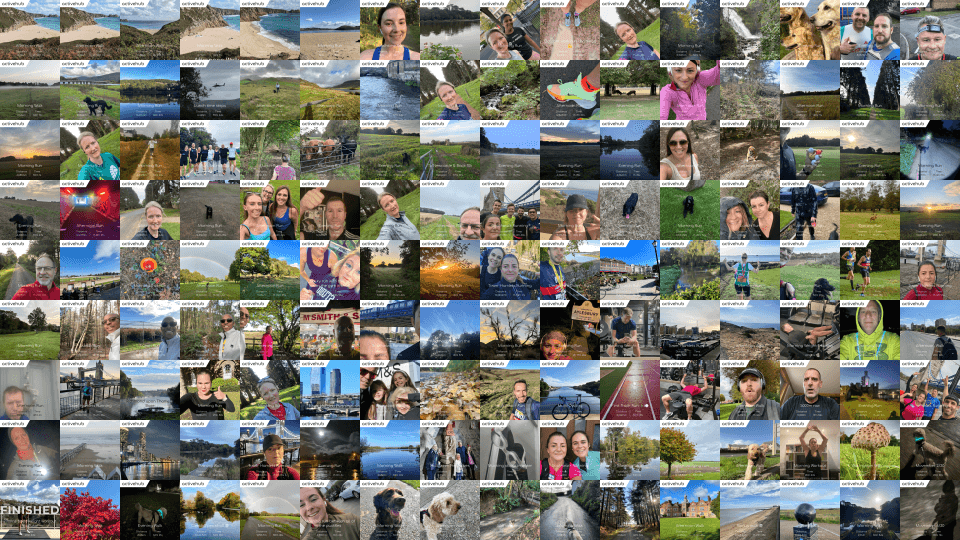
Every day, hundreds of activities are recorded across Total Active Hub, by users wanting to make a real difference to their physical health.
Our users are empowered by their employers to move at least 150 minutes per week whilst being rewarded with numerous incentives such as charity donations, trees and school meals.
Why not take a few moments to read and be inspired by our real-life success stories?
