-
Total Active Hub
A Whole City Moving for 30 Days. So Why Won’t Our Workplaces?
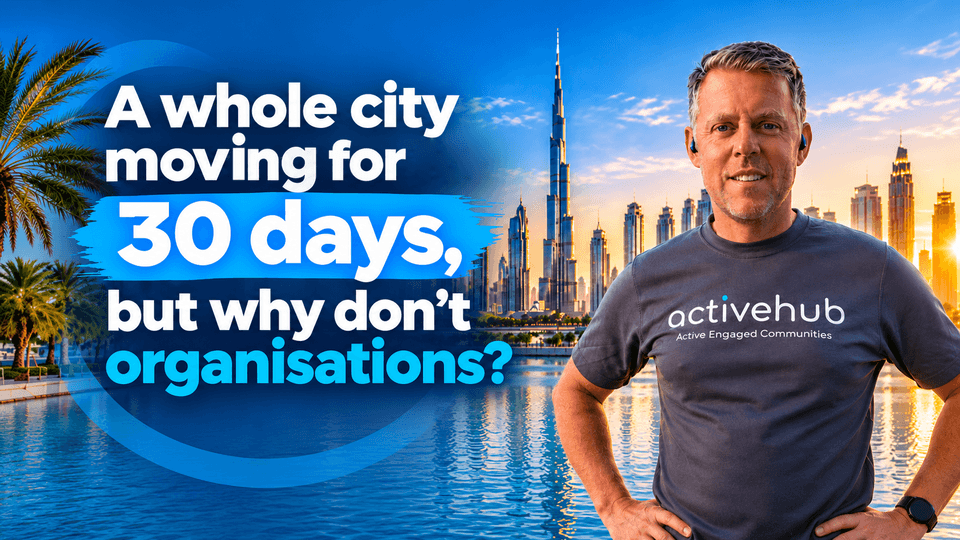
Today, an entire city commits to moving.
From 31 October to 29 November, the Dubai Fitness Challenge asks every resident and visitor in Dubai to do 30 minutes of activity a day for 30 days. Not a marathon. Not a gym membership. Thirty minutes, any way you like: a walk, a swim, a yoga class, a kick about with the kids.
This is its tenth edition. Last year more than 3 million people took part. The city’s main highway closes so people can run and cycle on it. Free classes appear in parks and on beaches. Schools, government departments and employers all sign up.
I find that genuinely remarkable. A city has decided, at the very top, that the health of its people is worth putting front and centre for a month every year. And it has kept that promise for a decade.
Which raises a question I can’t stop asking. If a whole city can do this, why can’t our organisations?
From 786,000 people to more than 3 million
The Dubai Fitness Challenge launched in October 2017 with one simple ask: 30 minutes of activity for 30 days. They called it 30x30, and it stuck.
The first edition drew 786,000 registered participants. Organisers also found that almost half the people at the flagship events hadn’t registered at all, so the real reach was over a million. Even in year one, the mix was telling: 44% of registrants came through schools, 33% were individuals or companies, and 23% came through government entities.
Then it grew, every single year:
- 2018: just over 1 million participants, up 34% on the first year
- 2021: 1.65 million, which organisers said was close to half of Dubai’s population
- 2022: more than 2.2 million, with over 285 fitness partners involved
- 2024: 2.73 million, up 14% on the year before
- 2025: more than 3 million, taking the total since launch past 16 million
The flagship events tell the same story. Dubai Run, where Sheikh Zayed Road (the city’s main artery) is closed to traffic and handed to runners, went from around 70,000 people in 2019 to more than 307,000 in 2025. Dubai Ride turned the same road into a cycling track for over 40,000 riders last year. Dubai Yoga and a stand-up paddle event at Hatta have since joined the line-up.
And it isn’t just about turnout. In 2024, 18% of participants reported improved physical fitness, 15% reported better psychological wellbeing, and 14% reported greater self-esteem and less anxiety.
Who is behind it, and why it matters to them
The challenge is the personal initiative of His Highness Sheikh Hamdan bin Mohammed bin Rashid Al Maktoum, Crown Prince of Dubai, Deputy Prime Minister and Minister of Defence of the UAE, and Chairman of The Executive Council of Dubai. It is delivered by Dubai’s Department of Economy and Tourism and the Dubai Sports Council, backed by presenting partners including DP World, Dubai Municipality and the Roads and Transport Authority.
That list matters. This isn’t a health department campaign tucked away in a leaflet. It is owned by the most senior leadership in the emirate and delivered by the people responsible for the economy, tourism, infrastructure and transport.
The stated ambition has been consistent from the start: to make Dubai one of the most active cities in the world. In 2019, Sheikh Hamdan described the challenge as a mission to unify the city in one truly inclusive fitness movement. The official site frames it in terms of physical, mental and social wellbeing, and closes with a call to make the UAE the most active country in the world.
Read between the lines and you can see three reasons it matters to them:
- Health as infrastructure. Dubai’s public health leaders have credited the challenge with raising awareness of how physical activity reduces lifestyle diseases. Prevention at population scale is cheaper than treatment at population scale.
- Community as strategy. The challenge brings residents, schools, government and business together around something everyone can join. Dubai Run is positioned as part of the city’s goal to be the best place to visit, live and work.
- Long-term change, not a one-off. Back in 2020, organisers said the challenge was about creating long-term impact and an overall lifestyle change. Around the time this year’s registrations opened, Sheikh Hamdan approved the strategy and budget of the Dubai Longevity Authority. That tells you where the thinking is heading.
And here is the bit I keep coming back to. Sheikh Hamdan doesn’t just endorse it. He leads Dubai Run from the front, and in 2023 he ran the 10km route alongside everyone else.
The irony I can’t ignore
Here is what fascinates me, and frankly frustrates me a little.
A city has decided that the health of its people is a strategic priority. It has put its most senior leader at the front of it, closed its busiest road for it, and measured the results every year for ten years.
Now think about the average organisation. Its entire business model depends on people performing well at every level, in every role, every day. Its people are its biggest cost and its biggest asset. And yet physical movement, the single most accessible thing we know of for energy, focus, mood and resilience, is nowhere near the front of what most organisations do.
At best it’s a perk. A discounted gym membership most people never use. A step challenge once a year that the already-fit win. A wellbeing week squeezed between quarter-end and the Christmas party. Then everyone returns to back-to-back meetings, eating lunch at their desks.
I know because I lived it. I spent years in corporate life, including at Samsung, which was an amazing job and the fastest growth period of my career. I loved it. I also burned the candle at both ends, and nobody ever put movement on my agenda. In the end it was rowing, and the simple consistency of getting up each morning to do it, that changed things for me. It’s ultimately why Total Active Hub exists.
It’s a bit ironic, really. A government can see that a healthier, more active population is a stronger one. Businesses, who need high-performing people more than almost anyone, mostly can’t. Or won’t.
(Don’t get me started on the NHS and how much more the government could do with movement. That’s a blog for another day.)
Six lessons for leaders in HR, wellbeing and engagement
You don’t need to close a motorway. But the Dubai Fitness Challenge is a blueprint, and almost every part of it translates into the workplace.
1. Lead from the front, not from a memo. The Crown Prince runs the route. That says more than any campaign ever could. The research backs this up: a study of more than 800 organisations found that leadership and organisational support predicted participation in wellbeing programmes more strongly than financial incentives did (Grossmeier et al., 2020). If your executive team isn’t visibly moving, don’t expect anyone else to.
2. Make the ask small and open to everyone. 30 minutes, any activity, any fitness level. Not a 10k. Not a leaderboard topped by the office marathon runner. The lower the barrier, the bigger the movement. In organisations, that means designing for the person who hasn’t exercised in years, not the person who already does.
3. Let the environment do the work. Dubai doesn’t just tell people to move. It closes roads, puts on thousands of free classes and builds fitness villages so moving is the easy option. The workplace equivalent is protected time, walking meetings, no-meeting lunchtimes and managers who actively give permission. Telling people to be active and then filling their diaries is not a strategy.
4. Make it collective, then let it spread. Schools, government, employers and families all take part together. Emirates Group had more than 22,000 employees take part last year. That matters because behaviour spreads differently from information. It needs reinforcement from more than one person, and it travels fastest through tight-knit clusters. In one well-known experiment, a behaviour spread more than four times faster through clustered networks than random ones (Centola, 2010). Teams, not individuals, are the unit that changes culture.
5. Treat it as a ritual, not an event. This is the tenth edition. It comes back every year, and it has grown every year. That consistency is the point. Research on habit formation found it takes a median of 66 days for a new behaviour to become automatic, with a range up to 254 days (Lally et al., 2010). Thirty days is the on-ramp, not the finish line. The organisations that get the most from a challenge are the ones that use it to launch something that keeps going.
6. Measure it and tell the story of the trend. Dubai publishes its participation and wellbeing results every year, and the trend itself becomes the message. That works inside organisations too. Telling people how others’ behaviour is changing over time can shift behaviour even when it is still a minority one (Sparkman and Walton, 2017). “22% of us are taking part” sounds like a failure. “Up from 12% last year, and rising in every department” sounds like a movement.
None of this is complicated. It just requires an organisation to decide, like Dubai did, that its people’s health belongs at the front of the agenda rather than the back.
Why I’m so proud to be part of it this year
I’m delighted to share that Total Active Hub is now working with the Dubai Fitness Challenge. We’re one of the challenge’s app partners, supporting people across Dubai to complete their 30x30 over the next 30 days.
It’s built on the same model as our National Fitness Day challenge: 30 minutes a day, for 30 days, in teams of four. Small teams, because that’s how movement spreads. Every minute counts, whatever the activity, and everyone is in it together.
You can find out how it works and join here: totalactivehub.com/dubai-fitness-challenge
And if you’re a leader in HR, wellbeing or engagement wondering what this could look like for your own people, whether in Dubai, across the Middle East or here in Europe, please reach out. Get in touch through totalactivehub.com. I’d love to share more about what we’re doing in Dubai and how organisations are using the same blueprint to put movement at the front of what they do.
A city has shown us what’s possible. Over the next 30 days, let’s see how many organisations are brave enough to follow.
Sources
Dubai Fitness Challenge: 2026 dates and 30x30
Dubai Fitness Challenge: about the challenge
Dubai Media Office: 10th edition announcement
WAM: registration opens for the 10th edition
WAM: 2025 edition concludes with over 3 million participants
TradeArabia: 2017 edition draws 786,000 people
Gulf News: 2018 participation passes one million
Gulf News: 2021 participation and impact
WAM: 2022 edition, 2.2 million participants
Dubai Media Office: 2024 results and new brand identity
Gulf News: Sheikh Hamdan’s 2019 call to residents
Dubai Media Office: 2020 edition closes
WAM: Sheikh Hamdan leads Dubai Run 2024
Gulf Business: Dubai Run growth and Dubai Longevity Authority
Fact Magazine: Sheikh Hamdan at Dubai Run 2023
Emirates Group: 22,000 employees take part in 2025
Grossmeier, J. et al. (2020). Workplace well-being factors that predict employee participation. American Journal of Health Promotion, 34(4)
Centola, D. (2010). The spread of behavior in an online social network experiment. Science, 329(5996)
Lally, P. et al. (2010). How are habits formed. European Journal of Social Psychology, 40(6)
Sparkman, G. and Walton, G. M. (2017). Dynamic norms promote sustainable behavior. Psychological Science, 28(11)
-
World Mental Health Day: What Movement Did for My Mind
blog
by
Total Active Hub
-
The Reality of Corporate Gym Discounts
blog
by
Total Active Hub -
New National Campaign Challenges UK Workplaces to Move 20 Minutes a Day
news
by
Total Active Hub -
What Keep Britain Working Means for How You Invest in Employee Physical Wellbeing
blog
by
Total Active Hub
-
-
Success Stories
Every day, hundreds of activities are recorded across Total Active Hub, by users wanting to make a real difference to their physical health.
Our users are empowered by their employers to move at least 150 minutes per week whilst being rewarded with numerous incentives such as charity donations, trees and school meals.
Why not take a few moments to read and be inspired by our real-life success stories?
